
Global teams no longer work in one language nor in one location. Enterprises collaborate across borders, hire global organizations, sell internationally, contribute in the meeting wholly and serve customers worldwide. This growing proportion has created a need for multilingual video conferencing. A growing population in these meetings involve participants that don’t speak in their own language.
Millions of meetings are happening across multiple time zones, industries and organizational size. The global video conferencing market was valued at $13.8 billion in 2025 and is on course to reach over $31 billion by 2034. Video conferencing enables seamless communication without the need for language barriers.
What is multilingual video conferencing?
Multilingual video conferencing is a category of video communication technology. It enables participants to speak different and multiple languages in a single meeting. These meetings are conducted in real-time, with real-time translation. Qordenate automatically translates conversations, with each person hearing and speaking their chosen and preferred language.
Video conferencing with live translation enables participants to speak in their own language. Hear its translated audio instantly. They can enable universal captions that are translated in their preferred language. Participants can equally participate without any language barriers.
How Multilingual Video Conferencing Works
The core pipeline is integrated with several AI technologies that work together simultaneously. The pipeline is essentially the same for every meeting. The speaker’s voices are entered into the system, when they are speaking, the voice goes through a series of steps, the processing stage and arrives at the listeners end, in their preferred language. If captions are enabled, they are visible on the screen. This pipeline process happens within seconds, making meetings natural and without pauses. The quality of every stage in the pipeline is very essential. The better the quality, the better the experience.
Stage 1- Audio
The participant’s voice is captured in the microphone. The spoken audio is then converted into real-time. Background noise, internet connection, no proper hardware can disrupt the voice in the processing stage. The translation accuracy will depend on how clear the audio is.
Stage 2 – Speech recognition
The audio is converted into text in real-time with the speech recognition technology. This is the stage that handles accents, dialects, specific vocabulary, the pace of the speaker and the background noise. These need to be understandable for speech recognition.
Stage 3 – Real-time translation
The transcribed text is translated from the source language in the target language. AI translation models are used to analyse the context, the tone, the meaning for accurate translations. Mostly, full sentences are processed, not just literal words.
Stage 4 – Voice delivery
The translated voice is cloned and delivered to the listener in their chosen language. It is delivered as the translated audio and if universal captions are enabled, it is visible as universal captions. It can be both simultaneously, universal captions and the translated voice cloned.
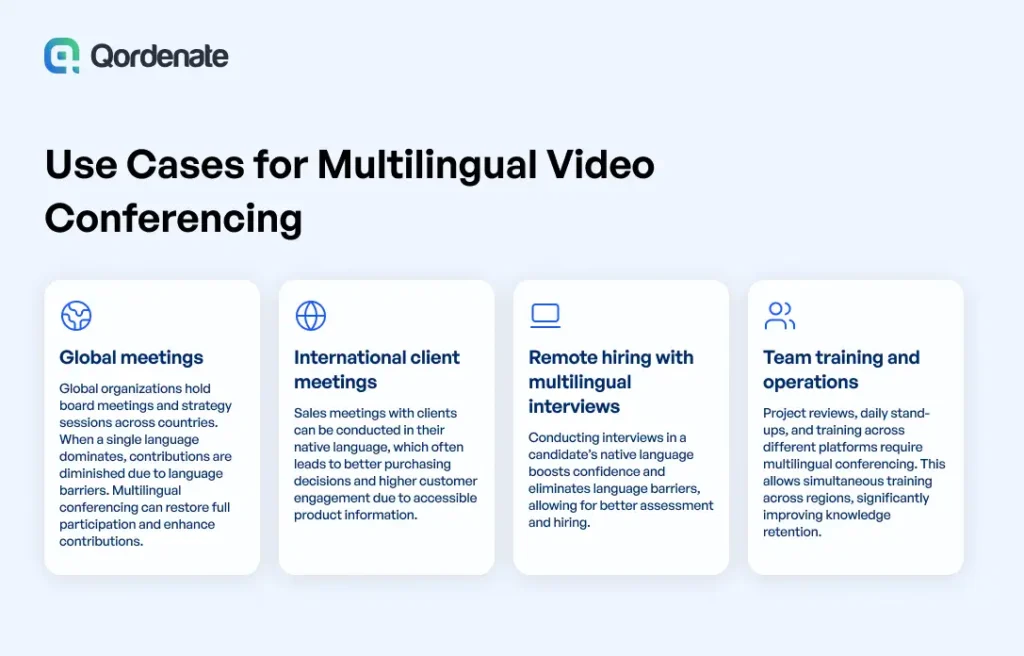
Use Cases for Multilingual Video Conferencing
Multilingual video conferencing is relevant and important wherever individuals don’t share a native language to communicate. This is a need for them. In the global economy, it is nearly everywhere.
Global meetings
Global organizations run board meetings, strategy sessions, leadership calls that span across multiple countries. In these meetings, if a single dominant language is spoken, the contributions of the speakers are systematically reduced. There is a language barrier, a language limitation. Multilingual conferencing would restore full participation to ensure proper contribution.
International client meetings
Sales meetings with clients for product disclaimers and negotiation deals can be conducted in the consumers language. Purchasing decisions made in the native language are often be beneficial, due to the product information being available in their native language. This leads to higher customer engagement.
Remote hiring and multilingual interviews
Interviews conducted in the candidate’s native language provide professional confidence, without requiring language fluency. Candidates are assessed and hired in their languages, removing the language barriers and miscommunication.
Training and team operations
Project reviews, daily stand-ups, cross functional team coordination calls and training employees across different platforms all require multilingual conferencing. The training of employees, partners, audiences across different regions vary and with multilingual video conferencing, they can be conducted simultaneously. The knowledge retained is greatly improved.
Industries that need multilingual video conferencing
Enterprises and multinational corporations
The enterprise sector, the large organizations with regional offices, the distributed teams, the international clients, and the cross border operations need inclusive and exclusive communication. They need multilingual communication for core operations and functions specialized for organizations that operate across five or more countries.
Healthcare
Healthcare providers provide and conduct accurate consultations with patients. Medical professionals communicate with international patients, researchers and healthcare organizations. Miscommunication risk is reduced and there are no misunderstandings.
Education
International universities, cross border research collaborations, and global online learning platforms can deliver multilingual lectures to international students. Researchers can benefit for research collaborations, students can benefit for academics. This improves the quality of the output. The reduction in language barriers would give a diversity to the researchers in the research output.
Legal and professional services
Cross border legal practices, immigration consultations and international relations all require multilingual communication. There should be a combination of security and accuracy for specific terminologies to be understood.
How Qordenate Delivers Multilingual Video Conferencing
Qordenate is built for multilingual meetings, a communication infrastructure designed to enable multilingual collaboration globally.
Real-time translation: Qordenate delivers real-time translation across multiple languages. The words are captured, processed, translated, and delivered to other participants in their chosen language.
Multiple languages: Qordenate supports a variety of languages. Participants can select their preferred languages and receive their outputs in the language selected.
No plugins or extensions: There is no software installation, no browser extension, no third-party app downloads. Participants can join directly from their devices.
Qordenate provides meeting recording, meeting summaries and analytics dashboard.
Multilingual video conferencing is an infrastructure of global communication. Qordenate connects you globally, with everyone.