There is a before and after in workplace communication, and the dividing line is AI communication in the workplace. For most of human history, if two people did not share a language, they could not fully communicate. They could gesture. They could point at things. They could, with effort and time, build a shared vocabulary. But the human communication including nuance, argument, emotion, expertise, wit was effectively unavailable across languages.
The workaround was human interpretation. The individuals who could hold two languages simultaneously and carry meaning across the gap. In 2026, the constraint is dissolving. Not completely. But at a pace and scale that would have been almost impossible to predict even a decade ago. Artificial intelligence has entered the conversation and the conversation will never be quite the same.
The meeting of human communication and artificial intelligence actually means how AI is changing the way we understand language, what it can genuinely do, where it still falls short. What it makes possible for the first time in human communication including in the specific context of global meetings, multilingual teams, and the platforms being built to serve them.
What Makes Human Communication So Hard to Replicate
Language is only part of it
When two people communicate face to face, spoken language carries perhaps 30 to 40% of the total information exchanged. The rest arrives through a tone of voice, which conveys confidence, sarcasm, warmth, hesitation, anger. Through facial expression, which confirms or contradicts what the words are saying. Through pace and pause, which signal emphasis, uncertainty, and the emotional weight of what is being said. Through cultural context, which determines whether directness reads as honesty or rudeness or whether silence reads as respect or rejection.

This is why translation has always been harder than it appears. A human interpreter is not simply processing words and substituting equivalents. They are navigating all of those layers simultaneously. They are carrying the speaker’s intent, tone, and cultural framing into a different linguistic and cultural system. The best interpreters describe the work as a kind of full-body cognitive immersion. The worst translation errors are the ones that start diplomatic incidents or lose clients and they are almost never about vocabulary. They are about everything that surrounds the vocabulary.
Language reflects how we think, not just what we think
There is a deeper complication. Language is not a neutral medium that transmits pre-formed thoughts. Language is what we think shapes the thoughts themselves. People conceptualise time, space, colour, and causality differently depending on their native language. A Spanish speaker and a Japanese speaker are not simply encoding the same ideas in different sounds. In real ways, they are thinking differently.
This is why AI-assisted communication is not to produce a perfect word-for-word translation. It is to carry meaning. It requires the AI to understand not just the grammar of both languages, but the conceptual frameworks they inhabit. That is a much harder problem. And it is the one the current generation of AI translation systems is making real, measurable progress on.
What AI Can Now Do in Human Communication
Real-time speech-to-speech translation
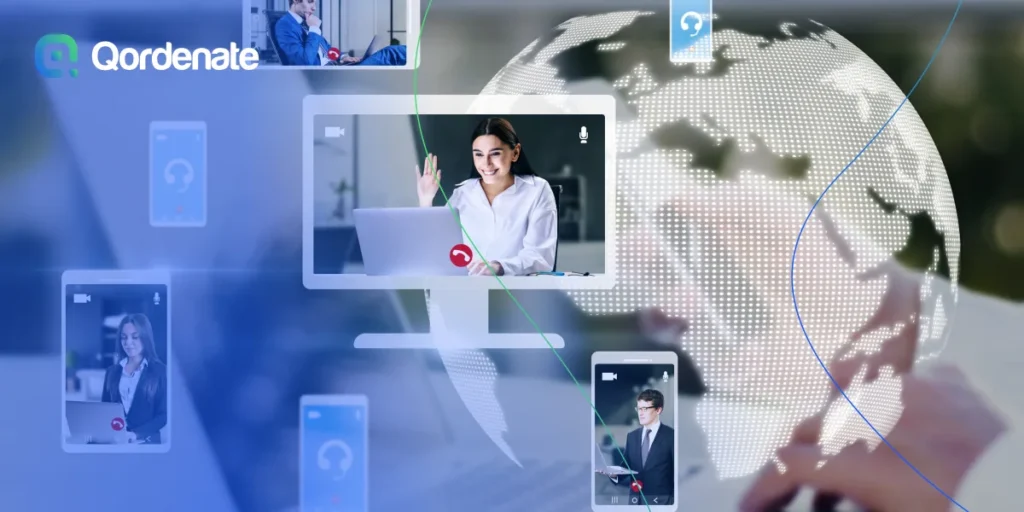
The most consequential development for global communication is real-time speech-to-speech translation. The ability to take spoken language in one language, and translate that text into another language, and synthesise it back into natural-sounding speech, all within a sub-second window that allows for something resembling natural conversation..
The applications are immediate: global business meetings without interpreters, medical consultations across language barriers, international education, cross-border legal proceedings, and a daily meeting of a distributed team that no longer has to default to whoever speaks the dominant language best.

Context-aware communication assistance
AI tools are increasingly embedded in the daily communication workflow. They are embedded in email, in messaging platforms, in document creation and offer contextual suggestions, tone adjustments, and clarity improvements. For non-native speakers working in a second language, these tools carry a specific practical value: they reduce the gap between what the person is trying to say and what arrives at the reader, removing the grammatical and register errors that can cause written communication in a second language to be read as less competent, less confident, or less clear than the writer intended.
How Qordenate Puts AI Into Practice
Real-time speech-to-speech translation native to the meeting
When a participant speaks in Qordenate, their words are captured, processed, translated, and delivered to other participants in their chosen language. The translation is not an overlay on a video call. It is the meeting architecture itself. The result is a room where language is no longer a proxy for power.
Security architecture that earns trust
Every audio, video, and translation exchange on Qordenate is encrypted point-to-point by default. Nothing is stored without explicit user choice. For organisations with sovereign data requirements, Qordenate deploys fully on-premises or in private cloud environments. This is a security feature. It is for the kind of serious, high-stakes communication that the platform is designed to serve.
What Comes Next
The trajectory of AI in human communication is clear. The technology will get faster, more accurate, and more contextually sophisticated. Language coverage will expand.
The more interesting question is not what the technology will do, but what organisations will choose to do with it. The same AI capabilities can be used to build communication infrastructure that expands who gets to participate fully in professional life or to build systems that increase efficiency while quietly concentrating power around those who already had the most of it.
AI in human communication is not a substitute for human connection. It is the infrastructure that makes connection possible across the diversity of the languages human beings actually speak.