
Language barriers are one of the biggest barriers in effective collaboration. Global teams are no longer limited by geography. Companies today hire internationally, serve global customers, and work across time zones and cultures. Running meetings in multiple languages are no longer optional. They are essential for productivity, inclusion, and business growth.
Why Language Barriers Hurt Meetings
Language differences do more than create confusion, they directly impact business outcomes. They damage meetings and are more costly than most organisations have quantified.
Miscommunication and Errors: When a non-native speaker participates in a meeting conducted in a second or third language, they are doing two jobs simultaneously: following the content of the discussion and translating it in real time. They need to listen critically, form arguments, evaluate ideas, and contribute original thinking. Participants can struggle to understand discussions leading to important details being missed. They could make wrong decisions, lead to project delays which will ultimately lead to reworking and inefficiency.
The participation gap: Language barriers produce a predictable participation pattern in meetings. The people most fluent in the meeting’s dominant language drive the discussion, and everyone else participates at the margins. They talk less frequently, with less nuance, and with less confidence. They hesitate to speak. The ideas they have remain unheard.
The hidden cost: The damage from language barriers is not limited to individual meetings. It compounds over time. A team member who consistently experiences meetings as environments where they cannot fully participate, where they are working harder than everyone else just to stay in the conversation, and still contributing less than they are capable of. They will disengage from the conversation. Gradually at first, then decisively. A hierarchy will be created, unintentionally. The fluent speakers will dominate conversations.
What to do before the meeting
Language Landscape: Before any multilingual meeting, the organiser should have a clear answer to these questions:
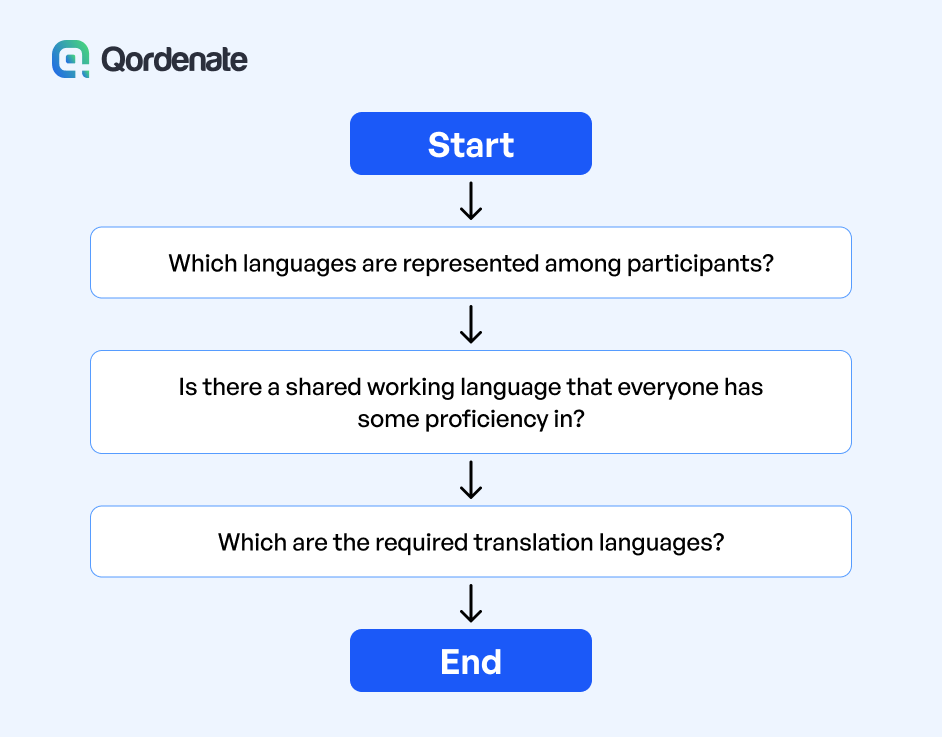
For regular team meetings you will know this instinctively.
Built an agenda: Send the agenda in all primary languages represented.
Use clear communication: Simple, structured language should be used. Avoid idiom, jargon, or culturally specific references.
Set up Qordenate
Join or schedule a meeting with Qordenate: Log into your Qordenate account and schedule a new meeting. From the settings, select the language you want for the session. Qordenate supports multiple languages and you can select your preferred language. You can schedule a meeting by adding the relevant details asked.
Joining the meeting: The meeting link is shared via email. Click on the meeting link and it will take you to the meeting. Join the meeting, configure the camera and microphone, and join.
The meeting landscape: After joining the meeting, you can enable real-time translation and universal captions from the icons at the bottom. Recording can be started. After the meeting ends, recording and the summary will be shared via email.
Best practices for Multilingual Meetings
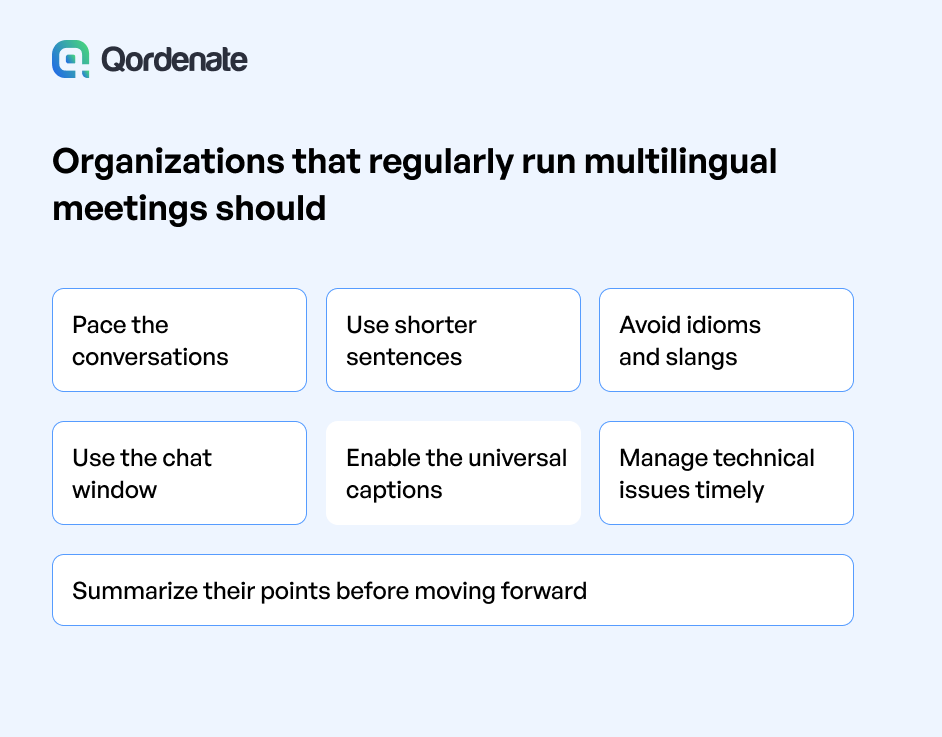
At the end of every multilingual meeting, cover three things explicitly: what was decided, who is responsible for what next, and by when. State each of these in plain, unambiguous language. Invite one final round of questions or flags before closing.
Qordenate FAQs
Languages supported by Qordenate include:
English, Arabic, Hindi, French, German, Italian, Russian, Chinese, Spanish, Portuguese, Polish, Turkish, Dutch, Czech, Hungarian, Korean, Japanese, Bengali, Catalan, Urdu, Tagalog, Indonesian, Danish, Estonian, Finnish, Maltese, Persian, Romanian, Slovak, Swedish, Thai, Ukrainian and Vietnamese.
The key features of Qordenate include real-time multilingual voice translation, universal captions, AI summarized meeting notes, meeting recording, in meeting chat, voice cloning, voicebridge and point-to-point encryption.
Qordenate is designed for enterprises, global teams, educators, legal professionals, and organizations conducting multilingual meetings, training sessions, and international collaboration.
Qordenate is ideal for schools, colleges, universities, and online learning platforms. It enables multilingual virtual classrooms with real-time translation and captions, improving accessibility for students worldwide.
Qordenate currently supports 50+ participants in a single meeting. This allows teams, classrooms, and global collaborations to connect seamlessly.
If technical issues arise, users should stay on the call provided their internet connection remains active. If the meeting continues to experience disruptions for 2–4 minutes, it is best to refresh the page and rejoin the session to reset the connection.
Qordenate’s VoiceBridge feature is designed to make meetings more inclusive. Participants who are deaf, hard of speaking, or have speech difficulties can type their message into the TTS box, and Qordenate will read it aloud during the meeting. This ensures they can actively participate in conversations and communicate with others.