
You made the video. Only one market can watch it.
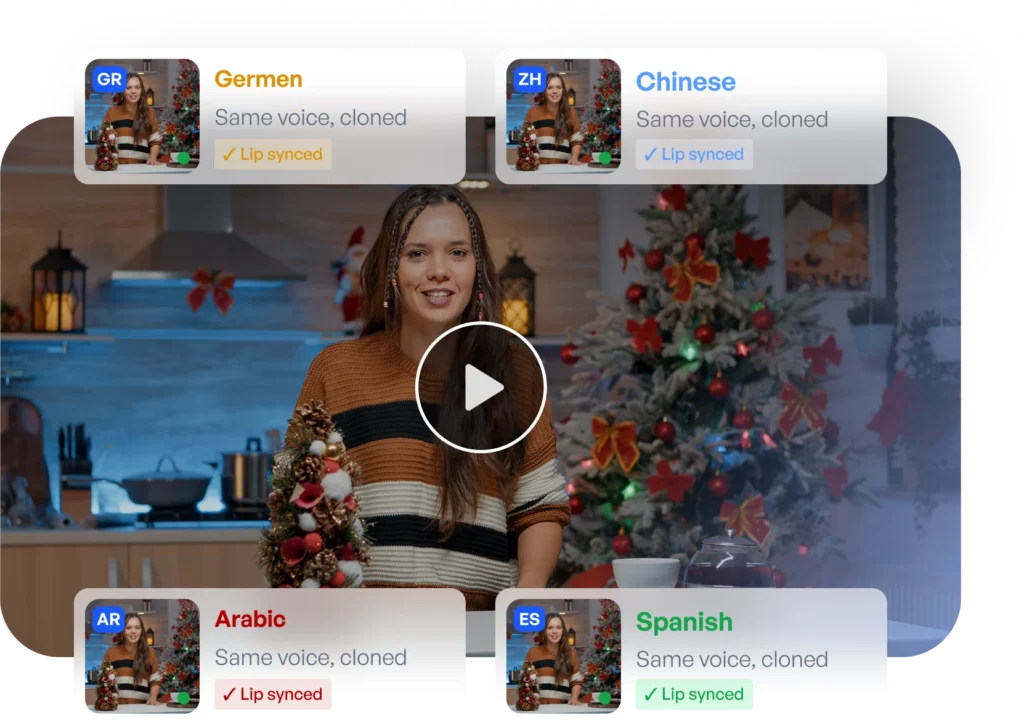
Faster localization workflow
Languages available
Voice cloning languages
The real cost of one-language content.
6–8 weeks per language, traditional route
Translation, voiceover casting, recording, editing, and syncing for every language.
$4,000+ average cost per language
Studio time, talent fees, and agency costs add up, so most teams localise just one language.
72% of viewers prefer their own language
Nearly 75% of global audiences prefer content in their native language over subtitles.
Two very different content problems. The same solution.
For enterprise and marketing teams
For creators and independent producers
The same content. Every market.
Traditional localisation
-
Translation agency:
1 to 2 weeks per language
- Voice talent casting and recording: 1 to 2 weeks per language
-
Audio edit and video sync:
1 to 2 weeks per language
With Qordenate
- Upload video and select target languages: 5 minutes
- AI translation, voice cloning, and lip-sync: automated
- All languages processed in parallel, not sequentially
Total: Minutes to hours. All languages at once.
Dubbix
AI video dubbing and content localisation. Upload once. Select your languages. Receive dubbed, lip-sync-aligned video in minutes. Voice cloning included. Free to start.
Questions contact centre teams are usually asked
The barrier isn't reach, it's infrastructure. Traditional video localisation requires translation agencies, voiceover casting, studio recording, audio editing, and lip-sync alignment, all done sequentially per language. That process takes 6 to 8 weeks and costs a lot per language. Most teams can only afford one or two languages, so the rest of the potential audience never gets the content. The content problem is actually a production cost and timeline problem.
You upload the video once, select your target languages, and Dubbix handles translation, voice cloning, lip-sync alignment, and delivery, all automated and processed in parallel. What traditionally takes 6 to 8 weeks per language, handled sequentially, is completed in minutes to hours across all languages at once. No casting, no recording studio, no agency coordination required.
Yes. Dubbix uses voice cloning technology to deliver dubbed audio in the original speaker's voice. This means a CEO video, a product walkthrough, or a training module sounds like the same person regardless of which language the viewer hears it in, maintaining authenticity and consistency across every market.
Dubbix is built for any video content that needs to reach multilingual audiences. Common use cases from the page include product launch videos for multiple markets, global compliance training rollouts, CEO communications to international teams, YouTube or online course content targeting new language regions, and podcasts expanding into new listener markets. Dubbix supports 33+ languages for localisation.
Traditional localisation costs more per language once studio time, talent fees, and agency costs are factored in, making it feasible for only one or two languages per project. Dubbix replaces that entire agency chain with a single platform, allowing enterprise teams to stretch campaign budgets across eight markets instead of two, and giving independent creators access to localisation that was previously only viable for large production budgets.
Dubbix is built for two distinct groups. For enterprise and marketing teams, it solves the problem of rolling out product launches, compliance training, or executive communications across multiple countries without the weeks-long agency process. For independent creators and producers, YouTubers, course creators, podcasters, it removes the language ceiling that limits an existing audience from growing into new markets. If your content already works in one language and there's an audience in another, Dubbix closes that gap.