

Global businesses have always been more connected. Teams span continents, meetings bring diverse perspectives and collaboration can happen across different time zones. Insightful insights are provided, decisions are taken on time, negotiations and deals are conducted properly. All of these are conducted due to language. However, when language barriers exist, there is a silent inefficiency. There is a source of organizational loss. The cost isn’t just linguistic. It is financial and strategic. It affects productivity, decision quality, employee retention and direct revenue.
The problems companies face
“Research reported in the Harvard Business Review put the annual cost of ineffective communication to U.S. companies up to $2 trillion”. This ineffectiveness in communication was driven by wasted time, doing rework, delaying important decisions, and missed opportunities.
This is not just miscommunication. It is missed insights that never got mentioned. It is the slower decision making cycle. It is the lower employee engagement and confidence in morale. It is the negotiation deals that fail due to lack of clarity.
“On the individual level, SIS International Research calculated that productivity losses from communication barriers cost organizations over $26,000 per employee per year”. Non native speakers generally simplify their ideas. They sometimes avoid contributing altogether. They take a lot longer to articulate thoughts.
Due to this miscommunication, organizations don’t get the best ideas, they get the most easily expressed ones. The easily expressive idea leads to weaker strategies, limited innovation and a narrow range of perspective that shapes the decisions.
“A landmark study by the Economist Intelligence Unit, surveying over 400 senior executives and managers, found that communication barriers in the workplace lead to delayed or failed projects for 44% of respondents. This made it the single most cited cause of project failure. The same study found that poor communication contributes to low employee morale in 31% of cases, missed performance goals in 25%, and lost sales in 18%.”
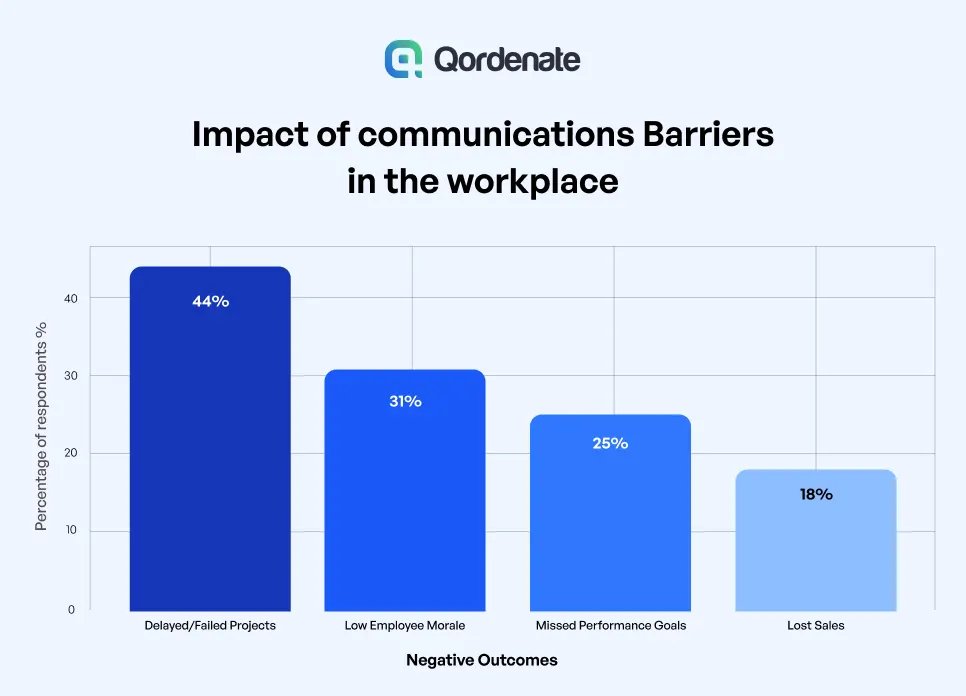
In business meetings, sales calls, partnership deals and business negotiations require clarity. Language barriers lead to misunderstood requirements, lack of trust between the colleagues, missed nuances in negotiating with clients and sometimes projects fail because they weren’t fully understood.
ROI effects
Language barriers have a direct and measurable impact on client relations, sales and international markets. The Forbes Insights and Rosetta Stone study “Reducing the Impact of Language Barriers,” based on surveys from executives at large US companies with revenues over $500 million, found that 65% of companies surveyed face language barriers that directly contribute to inefficiency, ineffective collaboration, and low productivity.
Language barriers weaken the global alignment. They can slow the growth of the company. They lead to reduced innovation and creativity. Language barriers directly shape the business outcomes. Miscommunication directly impacts the company’s profitability.
The solutions
Research published in the Harvard Business Review found that “linguistically diverse teams generate 20% more ideas during brainstorming sessions and produce solutions that are 18% more innovative than monolingual teams”.
This highlights the potential. This highlights the gap. The cost of the language barrier that is left unaddressed.
The Language Industry Market Report adds a useful counterpoint that businesses which proactively addressed communication challenges reported a 30% increase in project efficiency and a 25% reduction in project delays.
These are not just marginal gains. They are the basis of improvement available for organizations to address their problems and figure out solutions.
Researchers at Washington University in St. Louis, using data from eBay’s international trade platform, demonstrated that a moderate improvement in translation quality increased trade between countries by 10.9%.

This research identifies how moderate improvement in the translation quality uplifts the businesses profitability.
Global team efficiency research consistently shows that companies with genuinely multilingual communication capabilities expand into new international markets 1.5 times faster than competitors who lack them.
This research conveys languages being a market access mechanism, a communication tool for global businesses.
Multilingual languages in Global Meetings
Harvard Business School Professor Tsedal Neeley’s research on global teams identified what she described as a near-volcanic dynamic beneath the surface of multilingual organizations: language barriers create subgroup faultlines, erode psychological safety, and generate an “us versus them” dynamic that quietly undermines the collaboration quality organizations believe they are getting.
Individuals don’t feel confident, they don’t speak, they don’t question, they don’t challenge, or push back in the meeting. Hence, the room reaches a decision with incomplete information.
Communicating in their own language gives people the freedom to be more confident. Ideas flow more naturally between the teams. Participation in meetings will become better. Negotiations and decision making will happen faster. Stronger global collaboration between the teams, the clients and the employees will all improve instantly. There will be a higher employee engagement.
Innovation will increase. Creativity will boost. Productivity will be increased. There will be diversity in high quality insights produced overall. The business communication for the whole company will improve.